 Sharpe & Clear
 Free resource · Level I · 2027
CFA® Program Level I 2027 changes: new topic weights, renamed topics and what's new
From the February 2027 exam window, Level I runs on the 2027 curriculum. Two topic weights move by five points, two move by one point, four topic areas get new names, and most of the new content sits in Quantitative Methods and Equities. The exam format does not change.
Free PDF: our study playbook for CFA Program candidates, with a study plan you can copy. Get it by email
The 2027 changes in 30 seconds
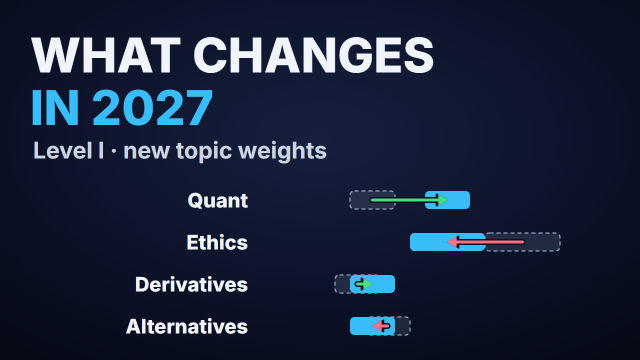
- Quantitative Methods: 6–9% → 11–14% (+5 points).
- Ethical and Professional Standards: 15–20% → 10–15% (−5 points).
- Derivatives, now Derivatives and Risk Management: 5–8% → 6–9% (+1).
- Alternative Investments: 7–10% → 6–9% (−1). The other six topics keep their weights.
- Four renamed topic areas, and new content mainly in Quant and Equities.
- For a 300-hour plan: about 15 hours move from Ethics to Quant.
- Same format: 180 questions in two 135-minute sessions. The November 2026 window still uses the 2026 curriculum.
Level I topic weights (weightage): 2027 vs 2026
CFA Institute gives each of the ten Level I topic areas a weight range: roughly the share of the exam that the topic accounts for. Here are both years side by side.
- 2026 range
- 2027 range
| Topic area (2027 name) | 2026 | 2027 | Change in points |
|---|---|---|---|
| Session 1 | |||
| Ethical and Professional Standards | 15–20% | 10–15% | −5 |
| Quantitative Methods | 6–9% | 11–14% | +5 |
| Economics | 6–9% | 6–9% | same |
| Financial Statement Analysis | 11–14% | 11–14% | same |
| Corporate Finance was Corporate Issuers | 6–9% | 6–9% | same |
| Session 2 | |||
| Equities was Equity Investments | 11–14% | 11–14% | same |
| Fixed Income | 11–14% | 11–14% | same |
| Derivatives and Risk Management was Derivatives | 5–8% | 6–9% | +1 |
| Alternative Investments | 7–10% | 6–9% | −1 |
| Portfolio Construction was Portfolio Management | 8–12% | 8–12% | same |
In one line: Quant gains five points at both ends of its range, Ethics gives up the same five, one point moves from Alternative Investments to Derivatives and Risk Management, and nothing else moves. Ethics is still a big topic: its 10–15% range has the same midpoint (12.5%) as the four topics weighted 11–14%.
The two groups follow the two exam sessions, as on CFA Institute's Level I exam page.
What the 2027 weights mean for a 300-hour study plan
CFA Institute says successful candidates report studying over 300 hours on average for each level. Treat 300 hours as a budget, and one point of exam weight is worth about 3 hours (1% of 300 hours).
| Topic area | 2026 | 2027 | Change |
|---|---|---|---|
| Quantitative Methods | 18–27 h | 33–42 h | +15 h |
| Ethical and Professional Standards | 45–60 h | 30–45 h | −15 h |
| Derivatives and Risk Management | 15–24 h | 18–27 h | +3 h |
| Alternative Investments | 21–30 h | 18–27 h | −3 h |
| The six other topics | same | same | 0 h |
So the practical change is simple: move about 15 hours from Ethics to Quant, and about 3 hours from Alternative Investments to Derivatives and Risk Management. These hours illustrate the weights; they are not official guidance, and your own split also depends on your background.
Start with Quantitative Methods: other topics reuse its tools, such as the time value of money and basic statistics. Our 6-month study plan for May 2027 turns the 2027 weights into weeks.
Four renamed topic areas
Four topic areas get a new name in 2027. They keep their place in the exam, and only Derivatives also changes weight.
| Name until 2026 | Name from 2027 |
|---|---|
| Corporate Issuers | Corporate Finance |
| Equity Investments | Equities |
| Derivatives | Derivatives and Risk Management |
| Portfolio Management | Portfolio Construction |
Ethical and Professional Standards, Quantitative Methods, Economics, Financial Statement Analysis, Fixed Income and Alternative Investments keep their names. If your notes, flashcards or question bank still use the old names, this is your translation table.
What's new in the 2027 Level I curriculum
CFA Institute announced the 2027 updates in a press release on 26 May 2026, with a one-page summary. The biggest rewrites are in Quantitative Methods and Equities, which together make up about a quarter of the Level I exam, and Ethics is reorganized at every level.
Learning modules per topic, 2026 vs 2027
| Topic area | 2026 | 2027 | Change |
|---|---|---|---|
| Ethical and Professional Standards | 5 | 10 | +5 |
| Quantitative Methods | 11 | 11 | 0 |
| Economics | 8 | 8 | 0 |
| Financial Statement Analysis | 12 | 12 | 0 |
| Corporate Finance | 7 | 7 | 0 |
| Equities | 8 | 12 | +4 |
| Fixed Income | 19 | 19 | 0 |
| Derivatives and Risk Management | 10 | 10 | 0 |
| Alternative Investments | 7 | 7 | 0 |
| Portfolio Construction | 6 | 6 | 0 |
| Total | 93 | 102 | +9 |
Counted in CFA Institute's public 2026 and 2027 Level I topic outlines (counts only).
A module count is not a weight. Ethics doubles its modules while its weight falls, because each Standard now has its own module. Quant keeps 11 modules but gains five points of weight. Plan your time by weight, and use module counts only to pace yourself inside a topic.
Quantitative Methods
- Rebuilt around practical uses, with more practice questions and quick knowledge checks inside the readings.
- More on estimation and simulation: historical simulation, bootstrapping and Monte Carlo, worked step by step in a spreadsheet (Excel or Google Sheets).
- Portfolio optimization gets more room, and now lines up with the Python Practical Skills Module (Levels I and II).
- A new reading on AI, large language models and financial data science.
- "Equation Explorers": interactive lessons in CFA Institute's Level I online platform, next to the time-value-of-money lessons. You change the inputs and watch tables and graphs respond.
- The separate Quantitative Methods prerequisite reading is retired from 2027.
Equities
- A more practical, job-oriented rewrite, with examples from several industries.
- Valuation is built on forecasts of the financial statements, modelling sales, margins, investment and financing one by one.
- Probability-weighted scenarios become a normal part of valuation.
- More industry and company analysis, with Five Forces and PESTLE tied to the valuation story.
- New modules on equity research reports, and on estimating the cost of equity with CAPM and multi-factor models.
Ethics, at all three levels
- Brought in line with the 12th edition of the Standards of Practice Handbook, including its updated guidance on every Standard.
- One module per Standard, each with practice problems: that is why Level I goes from 5 to 10 ethics modules.
Practical Skills Modules
- Updates to the Equity Analysis, Macro Insights for Investing and Python modules at Levels I and II.
- As before, you complete one Practical Skills Module before your Level I result is released.
What does not change in 2027
- 180 multiple-choice questions in two sessions of 135 minutes, 90 questions each: about 90 seconds per question.
- Three answer options per question (A, B or C), and no penalty for a wrong answer.
- Standalone questions: no item sets. Those start at Level II.
- Financial Statement Analysis questions follow IFRS unless a question says U.S. GAAP.
- Computer-based testing at test centres, in four windows a year.
- Over 300 hours of study per level, on average: what successful candidates report.
Which exam windows use the 2027 curriculum?
Your exam window decides your curriculum, not the date you started studying.
| Window | Testing dates | Curriculum |
|---|---|---|
| November 2026 | 11–17 Nov 2026 | 2026 |
| February 2027 | 22–28 Feb 2027 | 2027 |
| May 2027 | 11–17 May 2027 | 2027 |
| August 2027 | 15–22 Aug 2027 | 2027 |
| November 2027 | 13–19 Nov 2027 | 2027 |
Registration deadlines and fees for each window: Level I exam dates, deadlines and fees (2027).
What to do now
- Sitting in November 2026? Stay with the 2026 curriculum and weights: none of these changes applies to you.
- Sitting in 2027? Study with materials written for the 2027 curriculum. If you started with 2026 notes, check Quant, Equities and Ethics first: that is where the changes are.
- Re-weight your plan: about 15 more hours for Quant, 15 fewer for Ethics, and still a little Ethics every week.
- Update the topic names in your notes and flashcards.
- Register early: for May 2027, the early deadline is 14 October 2026 (USD 1,140 instead of USD 1,490). All dates: Level I exam dates 2027.
- Build your calendar: our Level I study plan for May 2027 is built on the 2027 weights.
Sources
All checked on 2 October 2026. CFA Institute's pages change, so check the originals before you decide.
- CFA Institute, Level I exam page: 2026 and 2027 topic weights, exam format, study hours, Practical Skills Module.
- CFA Institute, press release of 26 May 2026 on the 2027 curriculum updates.
- CFA Institute, Curriculum Changes for 2027 (one-page PDF).
- CFA Institute, dates and fees: exam windows and their dates.
- Module counts: CFA Institute's public 2026 and 2027 Level I topic outlines, linked from the Level I exam page.
Prefer to watch?
 Watch on YouTube
The 2027 changes, animated: the new weights side by side with 2026, and what they mean for your study hours.
Sharpe & Clear on YouTube →
Watch on YouTube
The 2027 changes, animated: the new weights side by side with 2026, and what they mean for your study hours.
Sharpe & Clear on YouTube →