 Sharpe & Clear
 Free resource · Level I · May 2027
A 6-month CFA® Program Level I study plan for May 2027
26 weeks and 300 hours, from Monday 9 November 2026 to the May 2027 exam window (11–17 May). Built on CFA Institute's 2027 topic weights, with a weekly rhythm you can keep. Copy it, then adjust it to your life.
Free PDF: our study playbook, with this plan's template, the weekly rhythm, a mistake log and an exam-day checklist. Get it by email
The plan at a glance
- 300 hours ÷ 24 study weeks = 12.5 hours a week, plus 2 spare weeks: 26 weeks in total.
- Weeks 1–19: learn the ten topics (18 weeks, plus a spare week over the holidays), with ethics every week.
- Week 20: spare week. Weeks 21–22: fix gaps.
- Weeks 23–26: three full mock exams, then a calm final week.
- Practical Skills Module done by week 8 (Sunday 3 January 2027).
- Register by 14 October 2026 for the early fee.
- Topic blocks 1–9
- Spare week
- Fix gaps
- Mock exam weeks
- Final week
- Exam window
- Ethics, 1.5 h a week
- Skills module done
- Week 13, halfway
How many hours a week? 300 hours ÷ your study weeks
CFA Institute's Level I page says successful candidates report over 300 hours of study on average. So the rule is simple: hours a week = 300 ÷ your study weeks.
| Study weeks | Hours a week |
|---|---|
| 30 weeks | 10 |
| 24 weeks (this plan) | 12.5 |
| 20 weeks | 15 |
| 16 weeks | about 19 |
For May 2027, plan 24 study weeks at 12.5 hours a week, then add 2 spare weeks for the weeks when life gets in the way: 26 weeks, starting on Monday 9 November 2026. Book the exam first, then plan backwards.
Starting in January instead? From Monday 4 January to the exam window, you have 18 weeks. Keep 2 spare, and 300 ÷ 16 is about 19 hours a week. Add hours rather than cutting the mock exams, and learn the heaviest topics first.
Hours per topic, based on the 2027 weights
The plan splits 18 learning weeks in proportion to the middle of each topic's 2027 weight range: 2½ weeks for a big topic (11–14%), 1½ weeks for a smaller one (6–9%) and 2 weeks for Portfolio Construction (8–12%). Each learning week gives 11 hours to the topic of the week and 1.5 hours to ethics.
| Topic area | 2027 weight | Weeks | Hours |
|---|---|---|---|
| Quantitative Methods | 11–14% | 2½ | 27.5 |
| Economics | 6–9% | 1½ | 16.5 |
| Financial Statement Analysis | 11–14% | 2½ | 27.5 |
| Corporate Finance | 6–9% | 1½ | 16.5 |
| Equities | 11–14% | 2½ | 27.5 |
| Fixed Income | 11–14% | 2½ | 27.5 |
| Derivatives and Risk Management | 6–9% | 1½ | 16.5 |
| Alternative Investments | 6–9% | 1½ | 16.5 |
| Portfolio Construction | 8–12% | 2 | 22 |
| Ethical and Professional Standards 1.5 hours in every learning week | 10–15% | — | 27 |
| Learning, weeks 1–19 | 18 | 225 | |
| Fixing gaps, weeks 21–22 | 2 | 25 | |
| Mock exams and final week, weeks 23–26 | 4 | 50 | |
| Total (plus 2 spare weeks) | 24 | 300 |
Why no ethics block? At 10–15%, ethics is a big topic, and judgment improves with many short sessions of questions rather than one cram week.
Why Quantitative Methods first? Other topics reuse its tools, such as the time value of money and basic statistics.
These are learning hours. The last six weeks (75 hours) revisit every topic, so each topic's full share ends up close to 3 hours per point of weight, the rule of thumb on our Level I 2027 changes page.
The 26 weeks, block by block
| # | Dates | Block | Weeks |
|---|---|---|---|
| Learn: weeks 1–19 | |||
| 1 | 9–25 Nov | Quantitative Methods | 2½ |
| 2 | 26 Nov – 6 Dec | Economics | 1½ |
| 3 | 7–23 Dec | Financial Statement Analysis | 2½ |
| 24–30 Dec | Spare week, over the holidays | 1 | |
| 4 | 31 Dec – 10 Jan | Corporate Finance Skills module done by Sunday 3 January | 1½ |
| 5 | 11–27 Jan | Equities | 2½ |
| 6 | 28 Jan – 14 Feb | Fixed Income Week 13 (1–7 Feb) is halfway | 2½ |
| 7 | 15–24 Feb | Derivatives and Risk Management | 1½ |
| 8 | 25 Feb – 7 Mar | Alternative Investments | 1½ |
| 9 | 8–21 Mar | Portfolio Construction | 2 |
| Catch up and fix gaps: weeks 20–22 | |||
| 22–28 Mar | Spare week | 1 | |
| 29 Mar – 11 Apr | Fix gaps | 2 | |
| Mock exams: weeks 23–26 | |||
| 12–18 Apr | Mock 1, Saturday 17 April | 1 | |
| 19–25 Apr | Mock 2, Saturday 24 April | 1 | |
| 26 Apr – 2 May | Mock 3, Saturday 1 May | 1 | |
| 3–9 May | Final week | 1 | |
| 11–17 May | Exam window | ||
Ethics runs next to every learning block, 1.5 hours a week. Use a spare week only if you fall more than a week behind; if you don't need it, spend it on extra questions.
A normal study week (12.5 hours)
The same slots every week beat motivation. Here is one way to fit 12.5 hours around a full-time job, for example 6:30–7:30 a.m. on weekdays, 9:00 a.m.–1:00 p.m. on Saturday and 2:00–5:30 p.m. on Sunday.
| When | Time | What |
|---|---|---|
| Monday to Friday | 1 h a day | 20 minutes of spaced review, then 40 minutes of new material or practice questions |
| Saturday | 4 h | New material, then a timed set of questions and its review |
| Sunday | 3.5 h | 1.5 h of ethics questions, 1.5 h on your mistake log and weak spots, 30 minutes to review the week and plan the next |
Over a week, that's roughly a third new material, a third practice questions, and a quarter review and mistakes. Only a third goes to new material, on purpose: testing yourself is where learning sticks.
Active recall and spaced repetition
Rereading feels productive, but it tests nothing. Active recall means closing the book and pulling the idea out of memory: a flashcard, a question, a formula rewritten from scratch. A large 2013 review of ten study techniques, published in Psychological Science in the Public Interest, rated practice testing and spaced practice the most useful; rereading and highlighting rated low.
Spaced repetition: review each item after 1 day, 3 days, 1 week and 3 weeks. Got it wrong? Back to day one. A flashcard app can schedule this for you.
- 20 minutes a day, every day: 10 minutes of due flashcards, 5 old questions, and 1 old mistake redone without looking.
- A mistake log: for each miss, write the cause, the fix, and a date to redo the question one week later.
Week 13: the week you'll want to quit
Week 13, 1–7 February 2027, is halfway. The exam still feels far away, and November's topics feel fuzzy. That's normal, and the plan already has an answer:
- The daily reviews keep the early topics alive: November is still there.
- Missed a few days? Don't double up. Drop the lost block and keep the rhythm.
- More than a week behind? That's what the spare weeks are for: one over the holidays, one in late March.
- Bad day? Promise yourself 10 minutes. Starting is the hard part.
The last 6 weeks: fix gaps, then mock exams
From week 21, you stop adding new material and start performing.
- Weeks 21–22 (29 March – 11 April): fix gaps. Weak topics first, mixed timed question sets, and your formula sheet rebuilt from memory.
- Week 23: mock 1 on Saturday 17 April. Review it the next day, then fix your three weakest topics.
- Week 24: mock 2 on Saturday 24 April, plus an ethics pass with many questions.
- Week 25: mock 3 on Saturday 1 May. Then redo your whole mistake log.
- Week 26 (3–9 May): final week. No new material: short reviews, flashcards and early nights.
A mock exam is a dress rehearsal: full length (180 questions in two sessions of 135 minutes), real timing, and the same time of day as your appointment. Spend as long reviewing a mock as sitting it. CFA Institute's Practice Pack FAQ suggests aiming for 70% on at least one of its official mock exams.
May 2027 deadlines
| Step | Date |
|---|---|
| Registration opens | 12 Aug 2026 |
| Early registration deadline (USD 1,140) | 14 Oct 2026 |
| Invoice payment deadline | 1 Jan 2027 |
| Registration closes (standard fee, USD 1,490) | 10 Feb 2027 |
| Scheduling deadline | 16 Feb 2027 |
| Disability accommodations request deadline | 17 Feb 2027 |
| Rescheduling deadline | 30 Apr 2027 |
| Exam window | 11–17 May 2027 |
Registering by 14 October 2026 saves USD 350. Deadlines fall at 11:59 p.m. U.S. Eastern Time. Every window, fee and rule: Level I exam dates, deadlines and fees (2027).
Your study plan checklist
- Register for May 2027 by 14 October 2026 for the early fee, or by 10 February 2027 at the latest.
- Book your test day and centre right after registering (deadline: 16 February 2027).
- Block 12.5 hours a week in your calendar: the same slots every week.
- Start Quantitative Methods on Monday 9 November 2026.
- Set up flashcards and a mistake log in week 1, then review 20 minutes every day.
- Finish your Practical Skills Module by Sunday 3 January 2027: you need one before your result is released.
- Put three mock dates in your calendar: Saturdays 17 April, 24 April and 1 May 2027.
- Practise with an approved calculator: a Texas Instruments BA II Plus (or Professional) or an HP 12C model from CFA Institute's list.
- Read CFA Institute's exam-day guide before your final week.
Sources
All checked on 2 October 2026. The plan itself is our own method, not official guidance.
- CFA Institute, Level I exam page: 2027 topic weights, "over 300 hours on average", exam format, Practical Skills Module.
- CFA Institute, dates and fees: May 2027 deadlines and fees.
- CFA Institute, Practice Pack FAQ: the 70% mock exam score to aim for.
- CFA Institute, calculator policy and exam-day preparation guide.
- Study techniques: "Improving Students' Learning With Effective Learning Techniques", Psychological Science in the Public Interest, vol. 14, no. 1, 2013.
Prefer to watch?
 Watch on YouTube
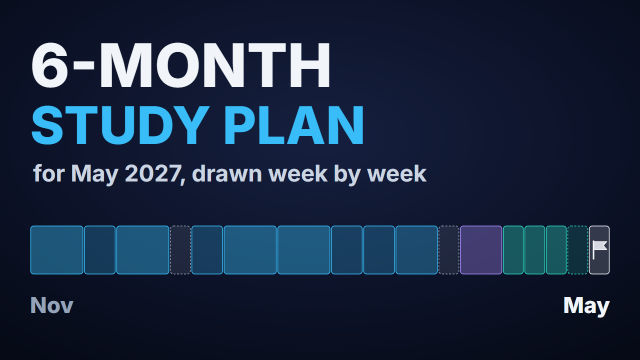
This plan, drawn week by week: hours a week, topic weights, spaced review, week 13 and the mock exams.
Sharpe & Clear on YouTube →
Watch on YouTube
This plan, drawn week by week: hours a week, topic weights, spaced review, week 13 and the mock exams.
Sharpe & Clear on YouTube →